

Published: 27 July 2026丨Author: Capital Business Centre Editorial Team丨Estimated reading time: 6 minutes 丨Suitable for: Hong Kong SME owners, startup founders, HR Managers, and Operations Directors
【Quick Takeaways】
Flexible leases, stylish interiors, and abundant social opportunities—“open-plan coworking spaces (Open-Plan Coworking Space)” were once seen by countless Hong Kong startup and SME leaders as the ideal solution.
But once teams actually moved in, the harsh reality set in: frequent staff sick leave, sharply reduced productivity, and the much-hoped-for “cross-team collaboration” turned into relentless noise interference.
Faced with this gap, many leaders often wonder if their management is at fault. In reality, the true root cause is the negative interference that Environmental Psychology exerts on the brain.
Let’s reconstruct a typical day for Hong Kong startup founder Alex. His team currently rents hot desks (Hot Desk) in a popular coworking space in Central:
10:00 AM: Alex is working on a critical investor pitch deck. Suddenly the marketing team at the next table starts brainstorming; the freelancer on his right is holding a Zoom call on speaker.
12:30 PM: To escape the noise, Alex puts on noise-cancelling headphones, yet people constantly walking by still flicker in his peripheral vision. He finds himself having to re-read a single contract clause three times.
03:00 PM: An enthusiastic neighbouring founder walks over to say hello: “Alex, how’s progress lately? Fancy a coffee?” Alex has no choice but to put down his work and socialise.
06:30 PM: The office gradually quiets down, yet Alex is already exhausted. After a full day of busyness, the most critical pitch deck has only two pages written.
Alex’s experience is far from unique. Behavioural research published in 2018 by Professor Ethan Bernstein of Harvard Business School showed that when companies moved from traditional offices to open-plan spaces, face-to-face direct communication among employees actually plummeted by about 70%, replaced by a surge in emails and Slack/WhatsApp messages.
Why does an open-plan design that claims to “promote collaboration” instead drive employees to retreat into their own worlds? The answer lies in how the brain works.
In Hong Kong’s high-cost commercial environment, open-plan spaces can indeed lower companies’ upfront rental costs. However, psychological research shows that continuous environmental stimulation makes it difficult for the brain to enter a highly efficient “Flow State”:
1. Attention Residue: The Cognitive Cost of Frequent Interruptions
According to the Attention Residue theory proposed by organisational psychologist Sophie Leroy in 2009: when people are forced to switch between tasks, residual thoughts from the previous task continue to occupy cognitive resources.
In open spaces, colleagues walking by, nearby phone calls, or impromptu discussions all trigger unconscious attention switches. Research shows that employees in open-plan environments experience micro-interruptions every few minutes on average, continually destroying work that requires deep thinking (Deep Work).
2. Social Surveillance Effect: Invisible Social Anxiety
Open spaces leave employees constantly exposed to others’ gazes. This “feeling of being observed” triggers ongoing self-monitoring and invisible anxiety, with particularly severe impact on introverted employees or roles requiring high concentration (such as software engineers, financial analysts, and legal advisors).
Under Hong Kong’s high-pressure work culture, the dual psychology of “not wanting to disturb others” and “fearing being disturbed” leads many to wear headphones all day to “appear invisible,” which in turn blocks genuine team collaboration.
3. Irrelevant Speech Effect: Cognitive Load Overload
Noise is the most common pain point in shared offices. The human brain is highly sensitive to “intelligible speech”; others’ conversations forcibly occupy our language-processing areas, greatly increasing Cognitive Load.
Research from Griffith University in Australia found that after just 8 minutes of exposure in a simulated open-office environment, employees’ negative emotions rose by 25%, while physiological stress indicators (skin conductance response) increased by 34%. Long-term accumulation easily leads to burnout.
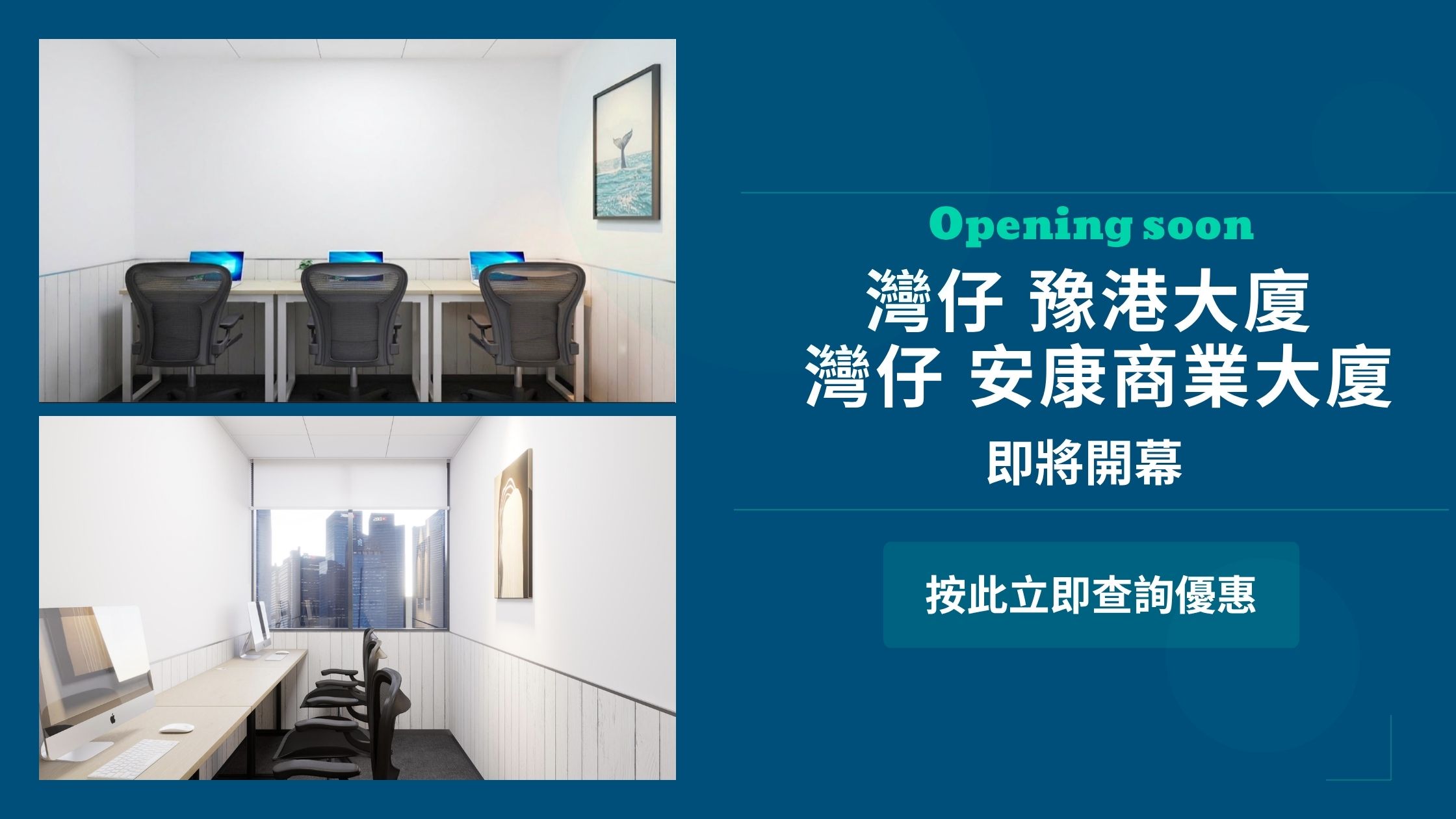
To balance “cost flexibility” with “team productivity,” more and more Hong Kong companies are shifting from pure open-plan Hot Desks / Dedicated Desks to private serviced offices that offer independent privacy.
|
Evaluation Dimension |
Open-Plan Shared Office (Hot Desk / Flexible Desk) |
Private Serviced Office (Private Serviced Office) |
|
Focus & Privacy |
Low (Frequent visual and noise interference; difficult to perform deep work) |
Extremely High (Independent physical private office with professional soundproofing) |
|
Team Collaboration Efficiency |
Medium (Easily causes social fatigue; often shifts to text messaging) |
High (Internal deep discussions can happen anytime; external interaction in dedicated lounges) |
|
Business Confidentiality & Security |
Low (Screens easily overlooked; phone calls lack privacy) |
High (Independent access control, soundproof phone booths, and dedicated private meeting rooms) |
|
Administrative & Operational Support |
Basic network and shared coffee machines provided |
Professional front-desk reception, mail handling, and IT infrastructure support provided |
|
Lease & Operational Flexibility |
Extremely High (Monthly or per-desk pricing) |
High (Flexible leases; can expand with team size at any time; no large fit-out costs) |
Answer: Yes. Multiple studies in environmental psychology and behavioural science confirm that while open-plan designs add visual liveliness, the lack of noise control and psychological safety causes employees to fall into “attention residue” and “social surveillance pressure.” For work requiring high concentration (such as coding, reviewing legal contracts, or financial analysis), efficiency often drops by 20% to 30% or more.
Answer: If your team has the following characteristics, a serviced office will be a higher-value choice:
Answer: The biggest advantages are “ready-to-use” and “extremely low capital expenditure (CAPEX).” Serviced office rental already includes a full suite of high-end furniture, high-speed internet, utilities and management fees, front-desk reception, and daily cleaning services. Companies need not bear hundreds of thousands to over a million dollars in expensive fit-out costs, nor sign rigid 2–3 year leases, significantly reducing cash-flow risk.
In Hong Kong’s fiercely competitive business environment, employees’ focus and mental health are a company’s most core assets.
Capital Business Centre deeply understands the profound impact of spatial psychology on business operations. Located in Hong Kong’s core business districts (Central / Wan Chai / Tsim Sha Tsui), we carefully create independent office solutions that combine premium privacy, acoustic design, and human-centred services.
Don’t let an unsuitable office environment silently erode your team’s productivity! [Contact Capital Business Centre now] to schedule a visit and customise a premium office solution for your team.